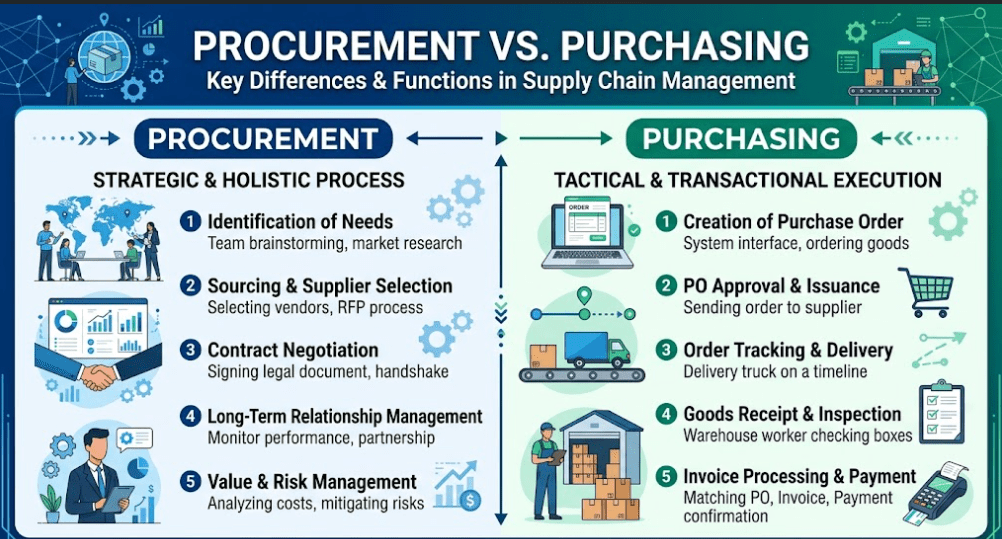
Purchasing vs. Procurement: Decoding the Supply Chain’s Most Confused Terms
Walk into any warehouse, logistics center, or corporate office, and you will hear “purchasing” and “procurement” used interchangeably. While they both relate to acquiring goods and services, treating them as the same thing is a common misstep.
In the broader landscape of Supply Chain Management (SCM) and enterprise systems like SAP, understanding the distinction is critical for building efficient workflows and maximizing value. Here is a breakdown of what sets them apart.
The Big Picture: Procurement (Strategic)
Procurement is the overarching, strategic process of sourcing and acquiring goods and services. It focuses on the long-term “Source-to-Pay” cycle. Procurement isn’t just about buying; it’s about establishing relationships, mitigating risk, and ensuring the business gets the best possible value over time.
Key activities include:
- Gathering business requirements and market research.
- Identifying, evaluating, and shortlisting vendors.
- Negotiating terms, pricing, and contracts (e.g., creating Outline Agreements or Scheduling Agreements).
- Continuous vendor performance evaluation.
Procurement is proactive. The goal is to build a reliable supply chain network that aligns with company goals.
The Execution: Purchasing (Transactional)
Purchasing is a specialized, operational subset of procurement. If procurement is the strategy, purchasing is the execution. It deals with the transactional “Procure-to-Pay” cycle—the literal act of ordering and paying for the goods once the strategic groundwork has been laid.
Key activities include:
- Creating and issuing Purchase Orders (POs) against established contracts.
- Expediting and tracking deliveries.
- Receiving goods into the warehouse (Goods Receipt).
- Processing invoices and authorizing payment (Invoice Verification).
Purchasing is reactive to immediate business needs. The goal is efficiency: getting the right item, in the right quantity, at the exact right time.
The Side-by-Side Breakdown
To see how these functions interact within a standard materials management flow, it helps to compare them directly:
| Feature | Procurement | Purchasing |
| Nature of Process | Strategic and proactive | Tactical, transactional, and reactive |
| Primary Goal | Maximize value, build relationships, mitigate risk | Efficiently acquire goods, minimize cost per transaction |
| Lifecycle | End-to-end (Source-to-Pay) | Subset of the lifecycle (Procure-to-Pay) |
| Key Documents | RFQs, Contracts, Vendor Evaluations | Purchase Orders (POs), Goods Receipts, Invoices |
| Focus | “Who should we buy from and on what terms?” | “How quickly and accurately can we execute this order?” |
Tying it Together in Enterprise Systems
In modern ERP environments, these concepts map directly to system architecture. The procurement team sets up the master data—evaluating suppliers, negotiating the terms, and creating the Purchasing Info Records and Source Lists.
Once that strategic foundation is laid, the purchasing team takes over the daily execution. When a Material Requirements Planning (MRP) run generates a Purchase Requisition, the purchasing team converts it into a PO, knowing that the pricing and vendor selection have already been optimized by procurement.
Understanding this division of labor is what allows businesses to move from simply “buying things” to running a highly optimized, automated supply chain.
For more SAP Procurement videos, you can search as GANESH SAP SCM in any search engine. Happy Learning.
Thanks, and Best Regards,
Ganesh
Discover more from GANESH SAP SCM
Subscribe to get the latest posts sent to your email.